Romanian employees: engagement champions, one step from burnout
September 17, 2026Florina Babau
Why does high engagement not guarantee team stability?
READ MORE
From spectacular graphics in a matter of seconds to chaos and budget overruns on the ground.
Read article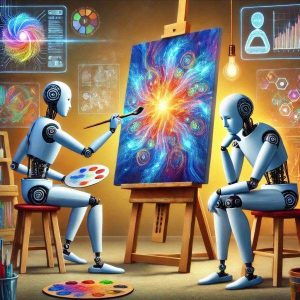
Generative AI (Gen AI) has been widely praised as the engine of a new creative era, letting a single person turn a handful of prompts into concepts, copy, photorealistic images, or complex storyboards in minutes. A large study cited from Harvard Business Review points to a more complicated picture: while Gen AI speeds up early-stage ideation, it also destabilizes traditional creative workflows and creates serious bottlenecks later in production. A year-long study of creative leaders in advertising and video/streaming production found that AI tool adoption has broken established workflows and driven up unplanned costs.
The “Illusion of Polish”: When a rough draft looks too finished
In classic creative workflows, early sketches or concepts were understood to be rough by nature. Clients knew that a mood board or a pencil sketch reflected general intent, leaving room for revision and technical adjustment. With Gen AI, even a first draft often looks like a polished final product. That flawless look creates a psychological trap: clients grow attached to specific details the AI generated more or less at random — perfect lighting, textures that can’t be physically reproduced, or hyper-detailed backgrounds. The concept a client signs off on looks launch-ready, but turning it into reality (real filming, 3D rendering, or physical production) can demand enormous resources or may not be feasible at all.
AI “Lone Wolves” and the isolation of production specialists
Traditionally, the creative process worked like a relay: art directors, writers, and technical teams (directors, producers, sound engineers) collaborated closely to make sure a great idea was also achievable. With AI tools, the concept phase has become increasingly solitary — a single creative can move quickly through brainstorming and hand a client a complete visual package, skipping technical consultation altogether. The result: production teams receive concepts the client has already approved, but which turn out to be impossible to execute within the allotted budget or timeline. That leads to unplanned overtime, rework, and frustrating renegotiations between clients, agencies, and vendors.
How organizations can avoid breaking their creative process ?
To capture the benefits of AI without falling into production bottlenecks, researchers recommend rethinking how teams collaborate:
Conclusion
Generative AI is a remarkable catalyst for ideation and visual exploration, but its speed can also break the bridge between vision and execution. Without strict process discipline and transparent communication, the speed AI brings at the start of a project can turn into major delays and costs at the end. The key to success isn’t just adopting new technology — it’s protecting human collaboration throughout the entire creative process.
Why does high engagement not guarantee team stability?
READ MORE
Discover what really motivates employees to innovate.
READ MORE
Why do early layoffs based on AI fail?
READ MORE