Amendments to the law 19/2020 on giving parents time off to supervise the children
March 23, 2020Liliana Savin
- it is established which are the working days for which the parents will receive an allowance.
READ MORE
Given the multitude of new regulations, press releases and confusion created in the media, we are resuming the main economic and fiscal-budgetary measures regulated by the 21th of March 2020.
The concrete measures established by the Government through the 29/2020 Emergency Decision are the following:
READ MOREAccording to a draft decision of the Romanian Government to be approved, in order to benefit from the measure adopted by the Government, which will cover from the unemployment insurance budget the benefits enjoyed by employees whose individual employment contracts are temporarily suspended on the initiative of their employer (pursuant to Article 52 (1) (c) of Law 53/2003 – Labor code, as modified and integrated, due to the effects of SAR-Cov-2 virus, companies must obtain a certificate of emergency situations (CSU).
How to request CSU
The request for issuing emergency situation certificates (CSU) will be made exclusively via the http platform://prevenire.gov.ro/, the platform will contain a dedicated section and will be operational within 5 days of the adoption and publication of the draft decision in the Official Journal.
Within the platform, the applicant shall provide information on:
READ MOREThe current context, triggered by the COVID19 epidemic, is already creating numerous difficulties and challenges for companies, with a new economic crisis on the horizon. The bill on the amendment of certain provisions of the Tax Code to change the payment deadlines for a series of substandard taxes in the next period was presented to the Chamber of Deputies yesterday.
Therefore, the taxes and duties in the bill are:
income tax for fiscal year 2019 and first quarter 2020;
income tax on micro-enterprises for the first quarter of 2020;
payroll taxes and salaries between February and April 2020;
Social health contributions related to wages received in the period February-April 2020;
READ MOREWe are living these days an exceptional period, in which all things happen differently than we were used to. But on how we will all mobilize to overcome this moment will also depend on the future evolution of things. And at such times, we believe that we must prove solidarity and contribute with everything we can to provide support to those around us.
At Ascent Group, our main resource is know-how. And these days we receive an avalanche of questions related to the latest legislative measures, the declaration of the state of emergency, the alternatives that employers have to make work more flexible during this period, medical leave, quarantine, fiscal measures to mitigate the impact of the crisis, etc.
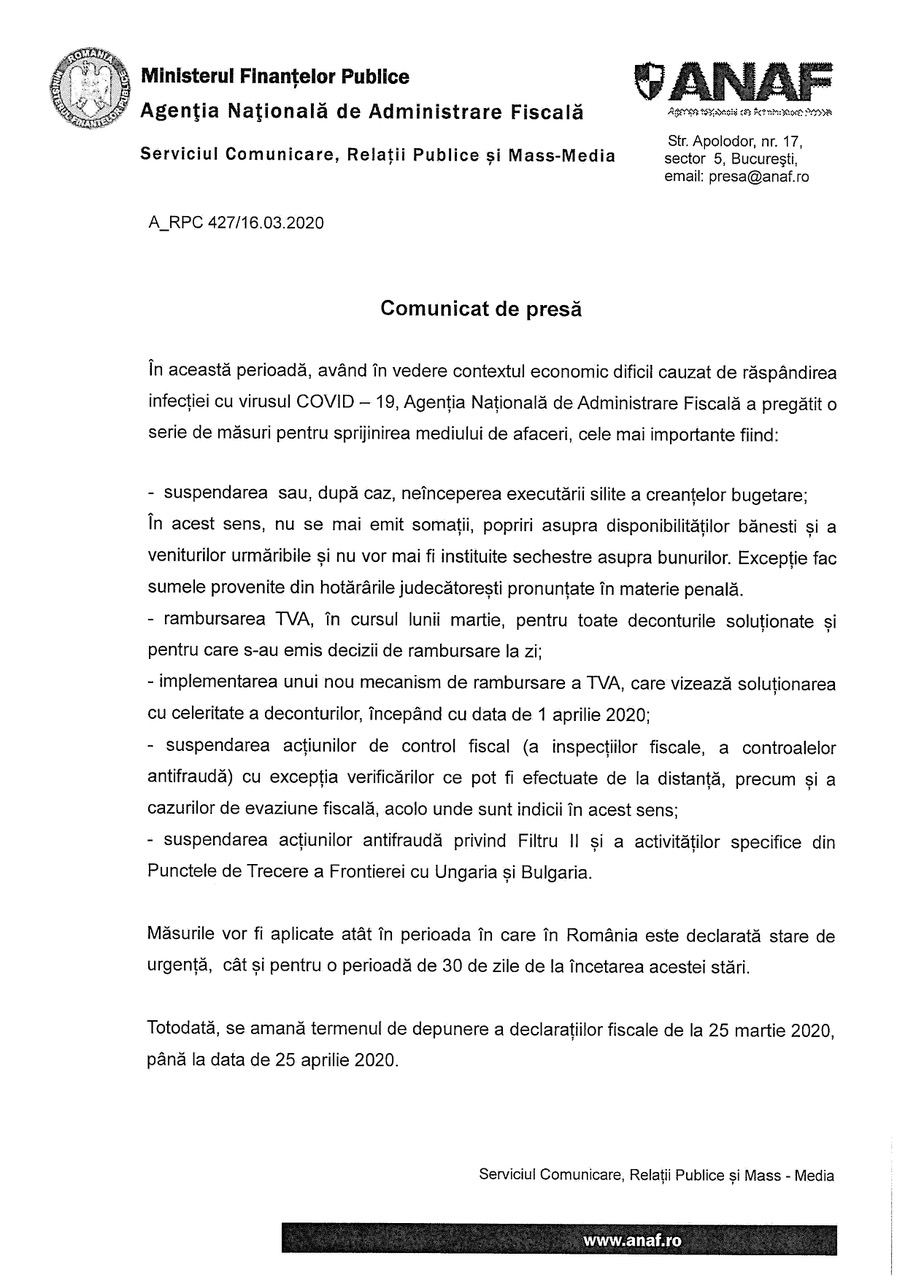
READ MOREAs a result of the difficult economic context caused by the COVID-19 coronavirus pandemic, the Minister of Finance, through a press release from the National Agency for Fiscal Administration (ANAF) announced today (Monday, 16.03.2020) a series of measures to support the business environment.
Below you can find an overview of the main provisions:
READ MOREToday, March 16, 2020, the President of Romania signed the Decree on establishing the state of emergency on the territory of Romania, for a period of 30 days. The President shall request Parliament to approve the measure adopted, within a maximum of 5 days from his issuance date.
Here are some of the measures that have an impact on the economic and social life:
In the economic field:
READ MOREThe press office of the National Health Insurance House published today, on the official website of the institution, a series of recommendations regarding the granting of medical leave and the quarantine payment.
According to the published text, in order to prevent illnesses and to recover the capacity to work, the insured persons can benefit from leave and allowance for quarantine, according to the regulations contained in the Government Emergency Ordinance no. 158/2005 regarding the holidays and indemnities of social health insurance, with the subsequent modifications and completions, as well as in the Norms of application of its provisions, approved by the Order of the Minister of Health and of the president of CNAS no. 15 / 1.311 / 2018, as subsequently amended and supplemented.
READ MOREIn the context created by the coronavirus (COVID19) pandemia, employers play a major role in reducing the risk of employee contamination with the new virus.
Apart of the implementation of additional hygiene measures and the correct information of employees on how to protect themselves, companies can adopt, in the framework of labour relations, solutions that make work schedule and the way of work more flexible.
One of the measures may be the decaling of the work programme, as state Secretary Raed Arafat recommends in the middle of last week.
READ MOREAs a result of the courses suspension in pre-university education in Romania, between March 11 and March 22, 2020, the public authorities have decided to take measures to help parents who cannot leave their children unattended.
Therefore, the Chamber of Deputies adopted on 12.03.2020, by unanimous vote, the legislative initiative that obliges all employers, both public and private, to grant paid days off to one of the parents in the situation of temporary closure of the schools due to adverse weather conditions or other extreme situations decreed by the competent authorities with responsibilities in the field.
The law also applies to single persons from the single-parent family, to the legal representative of the child and to the person designated to exercise the rights and fulfill the parental obligations towards the child.
Therefore, free days are granted for as long as the authorities decree the closure of schools.
READ MOREThe summer brouth a new Human Resources Manager in Ascent Group’s team. Starting in mid-June, Florina Băbău joined the Ascent Group team to coordinate the human resources activity of the group.
Florina is a graduate of the Faculty of Economic Sciences of the Western University of Timisoara and holds numerous certifications in the field of management and human resources. Being very passionate about learning and discovering new ways of developing people, Florina is currently continuing her education at the School of Psychology and Psychodrama.
Professionally, Florina has over 15 years of experience in human resources, both in multinational and local companies, in various roles such as: Improvement Coordinator, and subsequently Training & Development Coordinator for Leoni Wiring Systems Arad, HR Manager within ARED group, or HR Recruitment & People Development at Coficab Eastern Europe.
READ MOREOn the 21st of June the Emergency Ordinate number 43/2019 came into force. It brings significant changes to the regulations that have previously governed the construction industry.
Briefly, the changes brought by the EO 43/2019 are based on four pillars. These have implications for the minimum wage in the industry, on the one hand, and for the necessary conditions employers and employees need to fulfil in order to enjoy the financial benefits, on the other.
I. Minimum wage.
For the period comprised between 01.01.2020 and 31.12.2028, the minimum wage in the construction industry will be 3.000 RON, for a normal work schedule averaging around 167,333 hours per month. This will represent, on average, 17. 938 RON per hour.
READ MOREAscent Group continues it’s expansion plans, and July 2019 marks the opening of a new office, in Piatra Neamț.
The expansion decision is based both on Ascent Group’s strategic plan to be present in all Romanian’s regions and the business potential of Romania’s North-Eastern region, which is growing mainly on the IT&C serivces and shared services centers. An important role in the office opening decision played also identifiction of the right local partner.
READ MOREStarting with January 2019, the gross minimum wage will increase and will be differentiated according to the level of education.
The Government approved this week an Emergency Ordinance amending a number of normative acts, including the Labor Code – Law no. 53/2003, and Law no. 279/2005 on apprenticeship at the workplace. Amendments to the Labor Code will come into force on 1st January 2019 and aim to create the legal framework for establishing the minimum gross national salary guaranteed in pay by reference to the criteria for the level of studies.
Initially, the change envisaged differentiation according to the seniority in work, but in the end the Government dropped it, keeping only differentiation according to the level of education.
READ MOREIn case you have heard of Service Design and Design Thinking but do not know exactly what they are, this article is for you.
Have you ever entered a store, hotel or restaurant and felt that something was not entirely how it is supposed to be? That what you are looking for is not in the right place, that it takes too long for you to be served, or that many of the employees’ actions or operations are useless? Have you ever accessed a certain website and felt it was very complicated to find what you were looking for, doing unnecessary mouse movements and countless clicks until you found the button you needed
Have you ever felt that the people inside your organization who provide you with internal services (legal, HR, purchasing, ICT, etc.) do not always respond promptly and efficiently enough to your needs? Or that your whole experience in the organization is far from desired?
READ MOREThe law permitting the payment of dividends during the year was voted. According to the principle “autumn is a time of harvest “, perhaps from September or October this year we will already be able to reap the “fruits” of the business.
On July 12, the normative act (Law 163/2018) amending the dividend payment procedure was published, which allowes the distribution of the profit between the companies’ shareholders also quarterly, within the limit of the net profit realized after the preliminary filing of an interim financial statement .
READ MOREThe European Parliament and the Council of Europe adopted on 27 April 2016 the EU2016 / 679 Regulation on the protection of individuals with regard to the processing of personal data. Its provisions will be applicable in all Member States of the European Union as of 25 May 2018.
READ MORE2017 was a year of business growth and consolidation for Ascent Group, which was confirmed by the reported financial results. With a turnover increase of 14.9%, the group exceeds its own growth forecast, estimated at the beginning of the year at 10%, and for the first time in its history it has reached an annual turnover of EUR 3 million.
Not only the turnover shows a positive development, but all the main indicators of the group registered increases in 2017, respectively all types of services provided by the companies within the group had positive dynamics.
The year 2017 represented also a key year in the recognition of Ascent Group as a global training programs provider. This year, the training and coaching division of the group has won several important international projects, thus engaging in the formation of management teams in different countries in Central and Eastern Europe.
READ MOREThe year 2018 brings changes at all levels, including the General Employee Evidence Register and its submission to ITM via the Reges platform. According to Government Decision no. 905/2017, published on 19 December 2017 in the Official Gazette no. 1005, there are regulations regarding the new deadlines for transmitting changes to the contractual elements.
Thus, in August 2017, a new rule was introduced which stipulated that the change of any contractual clause must be registered and transmitted to ITM no later than one day before the date of its entry into force, in this way removing the provisions of the Labor Code stipulating the period of 20 days.
READ MOREThe year 2018 started with a lot of fiscal changes, contained in various normative acts. This is why we are trying to make a brief recap of the legislative changes that take place this year and a reminder of the main checks and declarations to be made at the beginning of the year:
READ MOREWith the latest tax changes some new information appeared regarding the micro-enterprise regime. They refer to the ceiling up to which a company is consider a micro-company and pays the tax on revenues, not on profits, the extention of this taxation system also to the companies who are now the now excluded, ans also the impossibility of companies with a certain share capital to switch from revenu tax to profit tax. The recent changes also include measures to combat outsourcing of profits made by multinational companies.
According to Government Emergency Ordinance no. 79/2017, published on November 10, starting with 1st of January 2018, will increase the ceiling to which a company becomes a taxpayer on micro-enterprise income, from 500,000 euros (as it is currently) to 1.000.000 euros.
This means that companies with a yearly turnover below 1.000.000 euros will not pay profit tax, but they will pay a 1% tax on the turnover.
READ MOREThe Ordinance no. 79/2017 regarding the amendment of the Fiscal Code approved by the Government on 08.11.2017 was published in the Official Gazette of 10.11.2017. This brings important news for both employees and employers.
The main change is represented by the transfer of contributions from the employer to the employee. Out of the total of 9 contributions currently paid by employers and employees, starting with 2018 there will be only 3 contributions, namely:
READ MOREEven if it seems hard to believe, in Romania, we will get rid of the stamp requirement!
This provision actually already existed from 2015, when a paragraph of the Law 316 already eliminated the corporate obligation to stamp the claims, declarations or other documents in relation to institutions or public authorities. However, a large proportion of the public sector employees continued to request abusively the application of the stamp on these documents.
In order to improve this situation, on 30 June 2017 it was published in the Official Gazette no. 507 a Government Ordinance that not only reaffirms the lack of stamp obligation, but also qualifies officials`demand to apply the stamp as being abusive.
READ MOREThursday, the 20th of July, the Romanian Government adopted a decision through which is the employers will have to pay the CAS and CASS contributions at the level of the minimum wage even for the part-time contracts.
Therefore, under this decision, employers will be required to pay social and health contributions at the level of the minimum wage even in the case of part-time contracts.
The measure is taken even if the salary of the part-time employee, related to the number of hours worked, is lower than the country-guaranteed minimum gross salary. Thus, for example, if the part-time employee earns 600 lei gross, the employer will be obliged to pay the pension and health contribution at the level of the minimum salary of 1450 lei gross.
READ MORE